Instant Connection for Pixel Streaming
— New Feature Automated Setup

How to Run After Effects on Googlebook
-
How to Run After Effects on Googlebook
How to Run After Effects on Googlebook
-
Table of Contents
A client sends over a product animation with two final changes: replace the logo and update the closing headline. You have the After Effects project, the source footage, and your Googlebook. You need a workspace where you can open the composition, make those edits, and export the finished video.
You can run After Effects on Googlebook by accessing a Windows cloud computer through your browser. Vagon Cloud Computer provides that desktop environment, with computing resources for editing, previews, effects, and rendering. After Effects runs on the cloud workstation while you control it from your Googlebook’s screen, keyboard, and mouse.
Adobe currently supports the desktop application on Windows and macOS, so this approach gives you access to the application your project requires. You can work with compositions, keyframes, expressions, and compatible plugins, then download the completed output.
This guide takes you from opening your cloud desktop to delivering the revised animation. Along the way, you will learn how to bring your project files across, choose performance for your workload, preview changes, and export a video ready to share.

Source: Adobe Help
Can You Run After Effects on Googlebook?
Yes, you can use After Effects from a Googlebook through a remote Windows workstation. You open the desktop application on that computer and control it through your Googlebook’s browser. The workstation handles the composition calculations, effects, previews, and final rendering.
For direct installation, Adobe’s current After Effects system requirements list Windows and macOS. Googlebook OS does not have an officially supported After Effects desktop installer. That applies whether your Googlebook uses an Intel or Snapdragon processor: the application also requires a supported operating system.
A cloud desktop gives you access to the familiar After Effects workspace. You can:
Open existing
.aepprojects and edit their compositions.Adjust text, footage, keyframes, expressions, and effects.
Install compatible Windows plugins and render finished deliverables.
The files and application run on the remote computer. Your Googlebook provides the screen and input controls, so its local memory does not determine how much RAM After Effects can use.
You will need an internet connection, an Adobe license that includes After Effects, and the assets required by your project. Once those are available, you can work through the same editing process you would use at a Windows desktop.
For the product animation in this guide, that means opening the supplied project, updating the logo and headline, checking the motion, and exporting the revised video.
Run Desktop After Effects Through Your Googlebook’s Browser
When you connect to a cloud workstation, you enter a Windows desktop where you can open After Effects, manage project folders, install fonts, and use other applications needed for the job. The browser displays that workspace and carries your keyboard and mouse input to it.
This gives you access to the desktop After Effects workflow. You can navigate precompositions, adjust keyframes in the Graph Editor, change expressions, and work with compatible effects. A project that needs a particular plugin can use its Windows version, provided that version supports your After Effects release and you have the required license.

Source: Adobe Help
The work is divided between your devices:
Your Googlebook | Your cloud workstation |
|---|---|
Displays the remote desktop | Runs Windows and After Effects |
Sends keyboard and mouse input | Processes edits, effects, and previews |
Maintains the browser connection | Stores the working project and cache |
Downloads the finished deliverable | Renders and saves the output |
For our product animation, the footage and composition are processed on the workstation. When you update the closing headline, After Effects calculates the changed frames using that computer’s resources. You view the result from your Googlebook and continue editing through the same interface.
Vagon’s performance options let you choose resources for the work ahead. A composition with animated text has different demands from one containing high-resolution footage, particles, or complex 3D effects. You can select an appropriate configuration as those demands change, while keeping your files in the same cloud environment.
That flexibility is useful when your everyday laptop suits your routine but a project requires more computing power or a Windows application. You can access the editing workspace from your Googlebook, complete the revision there, and bring the exported video back to your local files.
Start Using After Effects on Vagon in Four Steps
You can prepare your editing workspace during setup by selecting After Effects from the application catalog. Then connect from your Googlebook, sign in to Adobe, and upload your project through the built-in file storage. The application and assets will be together on your cloud computer, ready for the revision.
1. Create your cloud computer and select After Effects
Create your account and follow the setup flow for Vagon Cloud Computer. Choose a nearby location, select your starting performance, and allocate storage for the application, project media, cache, and exports.
During application selection, choose After Effects. Vagon’s preinstalled application setup installs your selected applications automatically while preparing the computer. You can include other tools you need for the project, such as Media Encoder.
For performance, Adobe recommends 16 GB of RAM for HD media and 32 GB or more for 4K and higher. Use those figures as a starting reference, then choose additional resources for more demanding compositions. You can change your performance option as the workload grows.
2. Connect from your Googlebook
Once the computer is ready, start it and connect through your dashboard. The Windows desktop opens in your Googlebook’s browser, with the selected applications available inside that workspace.
Switch to full screen for more room around the Composition and Timeline panels. Adjust display scaling so text and controls remain easy to read. A mouse is helpful for precise layer selection, keyframe adjustments, and Graph Editor work.
You now have a Windows editing environment controlled from your Googlebook. Its computing resources handle the application, while your laptop displays the session and sends your input.
3. Open After Effects and sign in to Adobe
Launch the installed After Effects application and sign in with an Adobe account whose plan includes it. Complete any activation prompts, then open the application’s workspace.
The automatic installation prepares the software; your Adobe subscription provides the entitlement to use it. Adobe licensing and cloud computer usage are separate.
If you are continuing a client project, check which After Effects version created it. You can manage eligible application versions through Creative Cloud when the project requires a particular release. Install any compatible plugins needed by that project before checking its final appearance.
For our product animation, you are ready to load the composition and locate the headline and logo.
4. Upload your project through Vagon Files
Open Vagon Files from your dashboard and upload the project package from your Googlebook. Drag and drop the files into the upload area, then wait for the transfer to finish.
You can upload while the cloud computer is stopped, so large transfers can happen before your editing session. Once connected, access the uploaded package from the Vagon Files folder inside Windows.
If it is a ZIP archive, extract it into a working folder. Keep the .aep, footage, audio, and other assets together, then open the project in After Effects.
Save a revision copy and begin editing. You can also place finished exports in Vagon Files to download them back to your Googlebook.
Open Your Project and Make the First Revision
Open the transferred .aep file and locate the composition you need to revise. For our product animation, start with the main composition, move the playhead to the closing headline, and inspect the logo layer. If the client supplied a reference video, use it to check the intended appearance and timing.
Before editing, save a copy with a clear name such as product_animation_revision_01.aep. That gives you a separate file for the requested changes.
Moving an existing project?
If you are preparing the files on another computer, use File > Dependencies > Collect Files before uploading them. Adobe’s Collect Files command gathers the project copy and required source media into a folder, with a report identifying dependencies.
Fonts and plugins need to be available on the cloud computer separately. If the project opens with a warning, address the named dependency before reviewing the animation. A substituted font can change headline spacing; a missing effect can alter the image.
Update the headline and logo
Select the headline’s text layer, or open its precomposition if the text is nested. Change the wording, then check line breaks, alignment, and whether the new text fits throughout the animation. Existing keyframes remain available, but a longer headline may need a layout adjustment.

Source: Adobe Help
For a replacement logo, select the original asset in the Project panel and choose Replace Footage > File. Select the new logo from your uploaded files. This updates instances that use that footage item, preserving the layer’s existing animation.
Inspect the replacement’s dimensions, transparency, scale, and anchor point. A differently sized source image may need adjustment to sit correctly in the design.
Scrub through the edited section and check the entrance, hold, and exit of both elements. Save the revision once they look correct. You can now build a preview to review the motion at playback speed.
Get More Power for Previews, Effects, and Rendering
The composition determines how much computing power you need. Updating a headline and logo may be straightforward, while calculating the finished animation can involve high-resolution footage, motion blur, lighting, and several layers of effects. Your cloud workstation supplies the resources for those calculations.
With Vagon’s performance options, you can choose a configuration for the work ahead and change it when the project becomes more demanding. That gives you room to handle larger compositions without replacing your Googlebook.
Choose resources around the work
After Effects uses CPU, memory, graphics hardware, and storage together. Each contributes to a different part of the experience:
Resource | Main contribution |
|---|---|
CPU | Calculates frames and processes multiple frames concurrently |
RAM | Holds preview frames and supports concurrent processing |
GPU | Accelerates supported effects and rendering features |
Fast storage | Provides space and access for footage, cache, and exports |
For text, logo, and basic motion graphics revisions, start with a configuration that comfortably meets the application’s requirements. Projects with 4K footage, many layers, or complex effects benefit from more memory and processing capacity.
Adobe’s system requirements recommend 16 GB of RAM for HD media and 32 GB or more for 4K and higher. These are starting references. Composition complexity, source formats, and plugins also affect resource use.

Source: Adobe Help
Use more processing capacity for demanding compositions
Multi-Frame Rendering allows After Effects to calculate multiple frames concurrently. It can improve previews and exports when the workstation has sufficient CPU capacity and memory, and the effects involved support it.
A stronger GPU helps effects and render features that use GPU acceleration. Its benefit depends on what the composition contains. A project dominated by CPU calculations will respond differently from one using demanding GPU effects.
For our product animation, preview a section containing the footage, headline, logo, and effects together. That shows how the workstation handles the actual revision. If the project needs more capacity, save your work and switch performance before continuing.
Keep space available for cached frames
After Effects stores calculated frames in memory and disk cache so it can reuse them during playback. Give the cache sufficient space on fast storage inside the workstation.
A cached preview can play more smoothly than its first calculation. After changing text, footage, or effects, the affected frames need to be calculated again.
This combination of suitable resources and reusable cached frames supports a practical workflow: make the revision, review the motion, and move to final rendering when the composition is approved.

Source: Adobe Help
Preview Your Changes and Export the Finished Animation
With the headline and logo updated, review the animation in motion. Scrubbing helps you inspect individual frames, while playback reveals timing, transitions, and whether the closing message stays visible long enough to read.
Set the work area around the revised section and run a preview. Give After Effects time to calculate and cache the frames. For quicker feedback while editing, choose Half or Quarter resolution in the Composition panel. These settings reduce preview detail; final output quality is controlled separately in the render settings.
Check the text layout, logo placement, animation timing, and audio together. Then review representative frames at Full resolution, particularly where small text, fine edges, or transparency matter.

Source: Adobe Help
Export an MP4 for review or delivery
Once the revision is approved, select the final composition and choose Composition > Add to Render Queue.

Source: Adobe Help
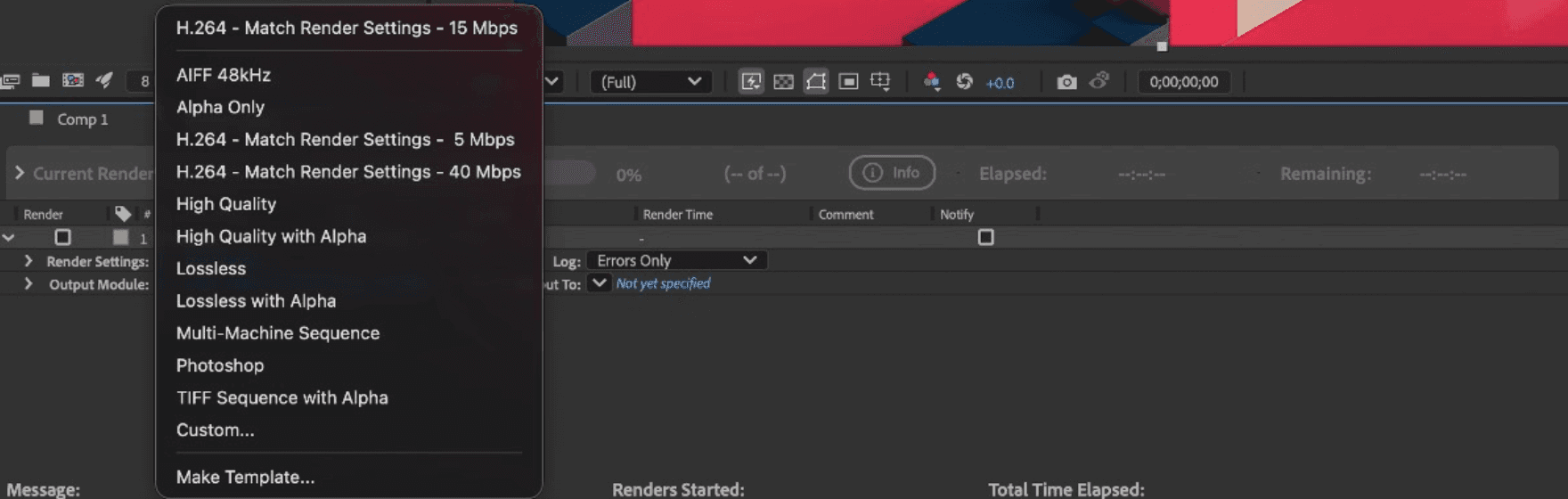
In the Render Queue:
Open Render Settings and confirm the resolution, frame rate, and time span.
Open Output Module and choose H.264 for an MP4 deliverable.
Use Format Options to set the encoding options required by the brief.
Select Output To and choose a folder on the cloud computer.
Start the render and wait for completion.
Current After Effects versions support H.264 export directly from the Render Queue. Adobe Media Encoder is also available when you want its preset and queue workflow.
Confirm that the time span includes the entire animation. A work area used for checking the headline could otherwise produce only that short section.
Source: Adobe Help
Choose a suitable format for transparency
If the client needs a graphic with a transparent background, use an alpha-capable format, such as ProRes 4444 or a PNG sequence. In the Output Module, select RGB + Alpha and match the required alpha interpretation. A standard H.264 MP4 does not preserve that transparency.
Check and download the finished file
Open the rendered output and verify its duration, dimensions, audio, and revised elements. Keep the cloud computer running until rendering finishes, and check its automatic stopping settings before a long export.
Save the deliverable in Vagon Files, then download it to your Googlebook. For transparency outputs, verify the alpha channel in an application that can display it correctly.
Keep Your After Effects Session Smooth
A responsive session makes it easier to adjust keyframes, inspect details, and review timing. Start with a stable internet connection and choose a Vagon location near you. Connection quality and distance affect how quickly your input reaches the workstation and the updated desktop reaches your screen.
If mouse movement or the whole desktop feels delayed, check the connection first. If the interface responds promptly but frames take time to calculate, investigate the composition and workstation resources. These symptoms point to different causes.
Keep the working project and its media together on the cloud computer. Once you have uploaded the package, you can continue editing there across sessions. Use a mouse and full-screen view to give the Timeline and Composition panels enough room.
For common interruptions, use these checks:
Issue | First action |
|---|---|
Missing footage warning | Locate the uploaded source files and relink the affected footage item. |
Headline spacing has changed | Activate or install the original font, then check the text layout. |
Preview calculates slowly | Lower preview resolution and inspect demanding effects or layers. |
Desktop input feels delayed | Check connection stability and the selected location. |
For a persistent preview bottleneck, enable the Timeline’s Render Time column. Adobe’s Composition Profiler helps identify layers and effects that take longer to calculate.

Source: Adobe Help
Before the final render, confirm the output folder has sufficient free space and save the project. After checking and downloading the deliverable, stop the cloud computer from your dashboard. You can return to the saved workspace when the client requests another revision, with the application and project files ready for the next session.
Final Thoughts
You can use your Googlebook to complete an After Effects project by accessing a supported desktop environment through your browser. Once the application and project assets are ready, you can make revisions, review the animation, and export the deliverable.
Start with a project you want to finish. Create your Vagon Cloud Computer, select After Effects during setup, and upload the project package. Choose computing resources around the composition’s needs, then keep the workspace available for future revisions.
FAQs
Can I install After Effects directly on Googlebook?
Adobe does not currently provide an After Effects desktop installer for Googlebook OS. Its supported platforms are Windows and macOS. You can access the Windows application through a cloud workstation and control it from your Googlebook’s browser.
How does Vagon run After Effects on Googlebook?
After Effects runs on a Windows cloud computer. Your Googlebook displays the remote desktop and sends keyboard and mouse input. The workstation processes the compositions, effects, previews, and renders using its own computing resources.
Do I need a powerful Googlebook to use After Effects?
Your Googlebook needs to handle the browser session and maintain a stable connection. After Effects uses the remote workstation’s CPU, RAM, and GPU. Your laptop’s display, input devices, and ability to decode the streamed desktop still affect the experience.
Do I need an Adobe subscription?
You need an Adobe license that includes After Effects. Selecting the application during cloud computer setup prepares the software, but does not include an Adobe subscription. Sign in with your licensed account to activate it. Adobe licensing and Vagon usage are separate costs.
Can I open existing .aep projects?
Yes. Transfer the project along with its linked footage, audio, and other assets. Adobe’s Collect Files command helps prepare that package. Required fonts and plugins must also be available on the workstation so the composition reproduces correctly.
Can I use After Effects plugins on Vagon?
You can install compatible Windows plugins inside the cloud computer. Check that the plugin supports your After Effects version and complete any required activation. A plugin used on a Mac may need a separate Windows installer, and its licensing terms determine whether you can activate it there.
Can I edit and render 4K compositions?
Yes, with a workstation configuration suitable for the project. Adobe recommends 32 GB of RAM or more for 4K media. Layer count, effects, source formats, and plugins also influence performance, so demanding compositions may need additional resources.
Can Googlebook’s Linux Terminal run After Effects?
Googlebook’s Terminal provides a Debian Linux environment, but Adobe does not offer a supported Linux version of After Effects. Enabling Terminal therefore does not provide an official After Effects installation route.
Can I download the finished video to my Googlebook?
Yes. Save the rendered file in Vagon Files and download it through your dashboard. Check the export before delivery, including its duration, dimensions, audio, and any transparency requirements. You can retain the working project for later changes.
Can I use this setup offline?
You need an internet connection to access and control the cloud workstation. After downloading the finished video, you can watch or share it locally using suitable applications. Continuing to edit the After Effects project through the remote desktop requires reconnecting.
A client sends over a product animation with two final changes: replace the logo and update the closing headline. You have the After Effects project, the source footage, and your Googlebook. You need a workspace where you can open the composition, make those edits, and export the finished video.
You can run After Effects on Googlebook by accessing a Windows cloud computer through your browser. Vagon Cloud Computer provides that desktop environment, with computing resources for editing, previews, effects, and rendering. After Effects runs on the cloud workstation while you control it from your Googlebook’s screen, keyboard, and mouse.
Adobe currently supports the desktop application on Windows and macOS, so this approach gives you access to the application your project requires. You can work with compositions, keyframes, expressions, and compatible plugins, then download the completed output.
This guide takes you from opening your cloud desktop to delivering the revised animation. Along the way, you will learn how to bring your project files across, choose performance for your workload, preview changes, and export a video ready to share.
Source: Adobe Help
Can You Run After Effects on Googlebook?
Yes, you can use After Effects from a Googlebook through a remote Windows workstation. You open the desktop application on that computer and control it through your Googlebook’s browser. The workstation handles the composition calculations, effects, previews, and final rendering.
For direct installation, Adobe’s current After Effects system requirements list Windows and macOS. Googlebook OS does not have an officially supported After Effects desktop installer. That applies whether your Googlebook uses an Intel or Snapdragon processor: the application also requires a supported operating system.
A cloud desktop gives you access to the familiar After Effects workspace. You can:
Open existing
.aepprojects and edit their compositions.Adjust text, footage, keyframes, expressions, and effects.
Install compatible Windows plugins and render finished deliverables.
The files and application run on the remote computer. Your Googlebook provides the screen and input controls, so its local memory does not determine how much RAM After Effects can use.
You will need an internet connection, an Adobe license that includes After Effects, and the assets required by your project. Once those are available, you can work through the same editing process you would use at a Windows desktop.
For the product animation in this guide, that means opening the supplied project, updating the logo and headline, checking the motion, and exporting the revised video.
Run Desktop After Effects Through Your Googlebook’s Browser
When you connect to a cloud workstation, you enter a Windows desktop where you can open After Effects, manage project folders, install fonts, and use other applications needed for the job. The browser displays that workspace and carries your keyboard and mouse input to it.
This gives you access to the desktop After Effects workflow. You can navigate precompositions, adjust keyframes in the Graph Editor, change expressions, and work with compatible effects. A project that needs a particular plugin can use its Windows version, provided that version supports your After Effects release and you have the required license.
Source: Adobe Help
The work is divided between your devices:
Your Googlebook | Your cloud workstation |
|---|---|
Displays the remote desktop | Runs Windows and After Effects |
Sends keyboard and mouse input | Processes edits, effects, and previews |
Maintains the browser connection | Stores the working project and cache |
Downloads the finished deliverable | Renders and saves the output |
For our product animation, the footage and composition are processed on the workstation. When you update the closing headline, After Effects calculates the changed frames using that computer’s resources. You view the result from your Googlebook and continue editing through the same interface.
Vagon’s performance options let you choose resources for the work ahead. A composition with animated text has different demands from one containing high-resolution footage, particles, or complex 3D effects. You can select an appropriate configuration as those demands change, while keeping your files in the same cloud environment.
That flexibility is useful when your everyday laptop suits your routine but a project requires more computing power or a Windows application. You can access the editing workspace from your Googlebook, complete the revision there, and bring the exported video back to your local files.
Start Using After Effects on Vagon in Four Steps
You can prepare your editing workspace during setup by selecting After Effects from the application catalog. Then connect from your Googlebook, sign in to Adobe, and upload your project through the built-in file storage. The application and assets will be together on your cloud computer, ready for the revision.
1. Create your cloud computer and select After Effects
Create your account and follow the setup flow for Vagon Cloud Computer. Choose a nearby location, select your starting performance, and allocate storage for the application, project media, cache, and exports.
During application selection, choose After Effects. Vagon’s preinstalled application setup installs your selected applications automatically while preparing the computer. You can include other tools you need for the project, such as Media Encoder.
For performance, Adobe recommends 16 GB of RAM for HD media and 32 GB or more for 4K and higher. Use those figures as a starting reference, then choose additional resources for more demanding compositions. You can change your performance option as the workload grows.
2. Connect from your Googlebook
Once the computer is ready, start it and connect through your dashboard. The Windows desktop opens in your Googlebook’s browser, with the selected applications available inside that workspace.
Switch to full screen for more room around the Composition and Timeline panels. Adjust display scaling so text and controls remain easy to read. A mouse is helpful for precise layer selection, keyframe adjustments, and Graph Editor work.
You now have a Windows editing environment controlled from your Googlebook. Its computing resources handle the application, while your laptop displays the session and sends your input.
3. Open After Effects and sign in to Adobe
Launch the installed After Effects application and sign in with an Adobe account whose plan includes it. Complete any activation prompts, then open the application’s workspace.
The automatic installation prepares the software; your Adobe subscription provides the entitlement to use it. Adobe licensing and cloud computer usage are separate.
If you are continuing a client project, check which After Effects version created it. You can manage eligible application versions through Creative Cloud when the project requires a particular release. Install any compatible plugins needed by that project before checking its final appearance.
For our product animation, you are ready to load the composition and locate the headline and logo.
4. Upload your project through Vagon Files
Open Vagon Files from your dashboard and upload the project package from your Googlebook. Drag and drop the files into the upload area, then wait for the transfer to finish.
You can upload while the cloud computer is stopped, so large transfers can happen before your editing session. Once connected, access the uploaded package from the Vagon Files folder inside Windows.
If it is a ZIP archive, extract it into a working folder. Keep the .aep, footage, audio, and other assets together, then open the project in After Effects.
Save a revision copy and begin editing. You can also place finished exports in Vagon Files to download them back to your Googlebook.
Open Your Project and Make the First Revision
Open the transferred .aep file and locate the composition you need to revise. For our product animation, start with the main composition, move the playhead to the closing headline, and inspect the logo layer. If the client supplied a reference video, use it to check the intended appearance and timing.
Before editing, save a copy with a clear name such as product_animation_revision_01.aep. That gives you a separate file for the requested changes.
Moving an existing project?
If you are preparing the files on another computer, use File > Dependencies > Collect Files before uploading them. Adobe’s Collect Files command gathers the project copy and required source media into a folder, with a report identifying dependencies.
Fonts and plugins need to be available on the cloud computer separately. If the project opens with a warning, address the named dependency before reviewing the animation. A substituted font can change headline spacing; a missing effect can alter the image.
Update the headline and logo
Select the headline’s text layer, or open its precomposition if the text is nested. Change the wording, then check line breaks, alignment, and whether the new text fits throughout the animation. Existing keyframes remain available, but a longer headline may need a layout adjustment.
Source: Adobe Help
For a replacement logo, select the original asset in the Project panel and choose Replace Footage > File. Select the new logo from your uploaded files. This updates instances that use that footage item, preserving the layer’s existing animation.
Inspect the replacement’s dimensions, transparency, scale, and anchor point. A differently sized source image may need adjustment to sit correctly in the design.
Scrub through the edited section and check the entrance, hold, and exit of both elements. Save the revision once they look correct. You can now build a preview to review the motion at playback speed.
Get More Power for Previews, Effects, and Rendering
The composition determines how much computing power you need. Updating a headline and logo may be straightforward, while calculating the finished animation can involve high-resolution footage, motion blur, lighting, and several layers of effects. Your cloud workstation supplies the resources for those calculations.
With Vagon’s performance options, you can choose a configuration for the work ahead and change it when the project becomes more demanding. That gives you room to handle larger compositions without replacing your Googlebook.
Choose resources around the work
After Effects uses CPU, memory, graphics hardware, and storage together. Each contributes to a different part of the experience:
Resource | Main contribution |
|---|---|
CPU | Calculates frames and processes multiple frames concurrently |
RAM | Holds preview frames and supports concurrent processing |
GPU | Accelerates supported effects and rendering features |
Fast storage | Provides space and access for footage, cache, and exports |
For text, logo, and basic motion graphics revisions, start with a configuration that comfortably meets the application’s requirements. Projects with 4K footage, many layers, or complex effects benefit from more memory and processing capacity.
Adobe’s system requirements recommend 16 GB of RAM for HD media and 32 GB or more for 4K and higher. These are starting references. Composition complexity, source formats, and plugins also affect resource use.
Source: Adobe Help
Use more processing capacity for demanding compositions
Multi-Frame Rendering allows After Effects to calculate multiple frames concurrently. It can improve previews and exports when the workstation has sufficient CPU capacity and memory, and the effects involved support it.
A stronger GPU helps effects and render features that use GPU acceleration. Its benefit depends on what the composition contains. A project dominated by CPU calculations will respond differently from one using demanding GPU effects.
For our product animation, preview a section containing the footage, headline, logo, and effects together. That shows how the workstation handles the actual revision. If the project needs more capacity, save your work and switch performance before continuing.
Keep space available for cached frames
After Effects stores calculated frames in memory and disk cache so it can reuse them during playback. Give the cache sufficient space on fast storage inside the workstation.
A cached preview can play more smoothly than its first calculation. After changing text, footage, or effects, the affected frames need to be calculated again.
This combination of suitable resources and reusable cached frames supports a practical workflow: make the revision, review the motion, and move to final rendering when the composition is approved.
Source: Adobe Help
Preview Your Changes and Export the Finished Animation
With the headline and logo updated, review the animation in motion. Scrubbing helps you inspect individual frames, while playback reveals timing, transitions, and whether the closing message stays visible long enough to read.
Set the work area around the revised section and run a preview. Give After Effects time to calculate and cache the frames. For quicker feedback while editing, choose Half or Quarter resolution in the Composition panel. These settings reduce preview detail; final output quality is controlled separately in the render settings.
Check the text layout, logo placement, animation timing, and audio together. Then review representative frames at Full resolution, particularly where small text, fine edges, or transparency matter.
Source: Adobe Help
Export an MP4 for review or delivery
Once the revision is approved, select the final composition and choose Composition > Add to Render Queue.
Source: Adobe Help
In the Render Queue:
Open Render Settings and confirm the resolution, frame rate, and time span.
Open Output Module and choose H.264 for an MP4 deliverable.
Use Format Options to set the encoding options required by the brief.
Select Output To and choose a folder on the cloud computer.
Start the render and wait for completion.
Current After Effects versions support H.264 export directly from the Render Queue. Adobe Media Encoder is also available when you want its preset and queue workflow.
Confirm that the time span includes the entire animation. A work area used for checking the headline could otherwise produce only that short section.
Source: Adobe Help
Choose a suitable format for transparency
If the client needs a graphic with a transparent background, use an alpha-capable format, such as ProRes 4444 or a PNG sequence. In the Output Module, select RGB + Alpha and match the required alpha interpretation. A standard H.264 MP4 does not preserve that transparency.
Check and download the finished file
Open the rendered output and verify its duration, dimensions, audio, and revised elements. Keep the cloud computer running until rendering finishes, and check its automatic stopping settings before a long export.
Save the deliverable in Vagon Files, then download it to your Googlebook. For transparency outputs, verify the alpha channel in an application that can display it correctly.
Keep Your After Effects Session Smooth
A responsive session makes it easier to adjust keyframes, inspect details, and review timing. Start with a stable internet connection and choose a Vagon location near you. Connection quality and distance affect how quickly your input reaches the workstation and the updated desktop reaches your screen.
If mouse movement or the whole desktop feels delayed, check the connection first. If the interface responds promptly but frames take time to calculate, investigate the composition and workstation resources. These symptoms point to different causes.
Keep the working project and its media together on the cloud computer. Once you have uploaded the package, you can continue editing there across sessions. Use a mouse and full-screen view to give the Timeline and Composition panels enough room.
For common interruptions, use these checks:
Issue | First action |
|---|---|
Missing footage warning | Locate the uploaded source files and relink the affected footage item. |
Headline spacing has changed | Activate or install the original font, then check the text layout. |
Preview calculates slowly | Lower preview resolution and inspect demanding effects or layers. |
Desktop input feels delayed | Check connection stability and the selected location. |
For a persistent preview bottleneck, enable the Timeline’s Render Time column. Adobe’s Composition Profiler helps identify layers and effects that take longer to calculate.
Source: Adobe Help
Before the final render, confirm the output folder has sufficient free space and save the project. After checking and downloading the deliverable, stop the cloud computer from your dashboard. You can return to the saved workspace when the client requests another revision, with the application and project files ready for the next session.
Final Thoughts
You can use your Googlebook to complete an After Effects project by accessing a supported desktop environment through your browser. Once the application and project assets are ready, you can make revisions, review the animation, and export the deliverable.
Start with a project you want to finish. Create your Vagon Cloud Computer, select After Effects during setup, and upload the project package. Choose computing resources around the composition’s needs, then keep the workspace available for future revisions.
FAQs
Can I install After Effects directly on Googlebook?
Adobe does not currently provide an After Effects desktop installer for Googlebook OS. Its supported platforms are Windows and macOS. You can access the Windows application through a cloud workstation and control it from your Googlebook’s browser.
How does Vagon run After Effects on Googlebook?
After Effects runs on a Windows cloud computer. Your Googlebook displays the remote desktop and sends keyboard and mouse input. The workstation processes the compositions, effects, previews, and renders using its own computing resources.
Do I need a powerful Googlebook to use After Effects?
Your Googlebook needs to handle the browser session and maintain a stable connection. After Effects uses the remote workstation’s CPU, RAM, and GPU. Your laptop’s display, input devices, and ability to decode the streamed desktop still affect the experience.
Do I need an Adobe subscription?
You need an Adobe license that includes After Effects. Selecting the application during cloud computer setup prepares the software, but does not include an Adobe subscription. Sign in with your licensed account to activate it. Adobe licensing and Vagon usage are separate costs.
Can I open existing .aep projects?
Yes. Transfer the project along with its linked footage, audio, and other assets. Adobe’s Collect Files command helps prepare that package. Required fonts and plugins must also be available on the workstation so the composition reproduces correctly.
Can I use After Effects plugins on Vagon?
You can install compatible Windows plugins inside the cloud computer. Check that the plugin supports your After Effects version and complete any required activation. A plugin used on a Mac may need a separate Windows installer, and its licensing terms determine whether you can activate it there.
Can I edit and render 4K compositions?
Yes, with a workstation configuration suitable for the project. Adobe recommends 32 GB of RAM or more for 4K media. Layer count, effects, source formats, and plugins also influence performance, so demanding compositions may need additional resources.
Can Googlebook’s Linux Terminal run After Effects?
Googlebook’s Terminal provides a Debian Linux environment, but Adobe does not offer a supported Linux version of After Effects. Enabling Terminal therefore does not provide an official After Effects installation route.
Can I download the finished video to my Googlebook?
Yes. Save the rendered file in Vagon Files and download it through your dashboard. Check the export before delivery, including its duration, dimensions, audio, and any transparency requirements. You can retain the working project for later changes.
Can I use this setup offline?
You need an internet connection to access and control the cloud workstation. After downloading the finished video, you can watch or share it locally using suitable applications. Continuing to edit the After Effects project through the remote desktop requires reconnecting.
Get Beyond Your Computer Performance
Run applications on your cloud computer with the latest generation hardware. No more crashes or lags.

Trial includes 1 hour usage + 7 days of storage.
Summarize with AI
Ready to focus on your creativity?
Vagon gives you the ability to create & render projects, collaborate, and stream applications with the power of the best hardware.
Vagon Blog
Run heavy applications on any device with
your personal computer on the cloud.
San Francisco, California
Solutions
Vagon Teams
Vagon Streams
Use Cases
Resources
Vagon Blog
How to Run Blender on Googlebook
How to Run After Effects on Googlebook
How to Use SketchUp With Codex: MCP and Computer Use
How to Use SketchUp With Claude: MCP and Computer Use
How to Use ComfyUI With Codex: MCP and Computer Use
How to Use Godot With Codex: MCP & Computer Use Guide
How to Use Houdini With Codex: MCP, Computer Use & RBD
How to Use Cinema 4D With Codex: MCP & Computer Use
How to Use Higgsfield With Codex: MCP & Computer Use
Vagon Blog
Run heavy applications on any device with
your personal computer on the cloud.
San Francisco, California
Solutions
Vagon Teams
Vagon Streams
Use Cases
Resources
Vagon Blog
How to Run Blender on Googlebook
How to Run After Effects on Googlebook
How to Use SketchUp With Codex: MCP and Computer Use
How to Use SketchUp With Claude: MCP and Computer Use
How to Use ComfyUI With Codex: MCP and Computer Use
How to Use Godot With Codex: MCP & Computer Use Guide
How to Use Houdini With Codex: MCP, Computer Use & RBD
How to Use Cinema 4D With Codex: MCP & Computer Use
How to Use Higgsfield With Codex: MCP & Computer Use
Vagon Blog
Run heavy applications on any device with
your personal computer on the cloud.
San Francisco, California
Solutions
Vagon Teams
Vagon Streams
Use Cases
Resources
Vagon Blog