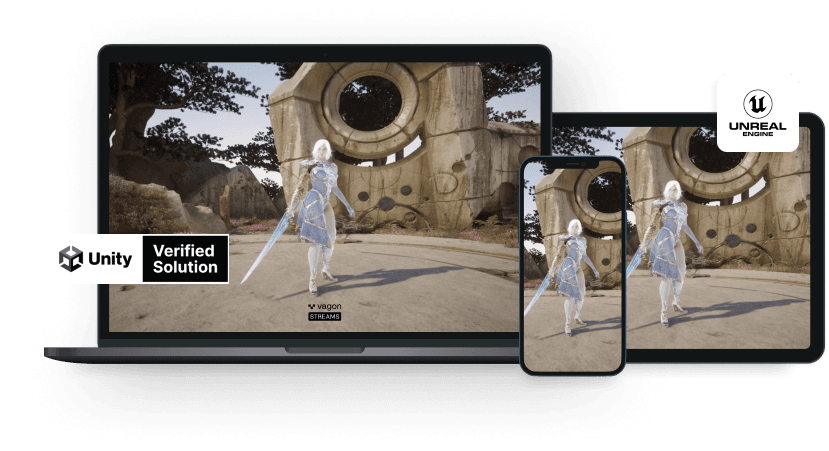
Real-time 3D Streaming
Definition
Streaming 3D content in real-time to various devices, enabling users to interact with 3D models and environments without the need for powerful local hardware. Real-time 3D streaming is essential for applications like virtual reality and remote collaboration.
Cloud Streaming Glossary · 85 terms
What is Real-time 3D Streaming?
Real-time 3D Streaming refers to the process of streaming 3D content in real-time to various devices, enabling users to interact with 3D models and environments without the need for powerful local hardware. Real-time 3D streaming is essential for applications like virtual reality (VR), remote collaboration, and interactive simulations, where high-quality, responsive 3D content must be delivered seamlessly.
Use Cases
Real-time 3D streaming is crucial in a variety of scenarios where immediate interaction with 3D content is required:
Virtual Reality (VR): Real-time 3D streaming allows VR environments to be rendered and streamed from the cloud, enabling users to experience immersive virtual worlds on less powerful devices.
Remote Collaboration: Teams working in design, engineering, or architecture can use real-time 3D streaming to collaborate on complex 3D models in real-time, regardless of their physical location.
Interactive Simulations: Real-time 3D streaming is used in training and educational simulations, where users need to interact with dynamic 3D environments that are streamed directly to their devices.
Online Gaming: Gamers can stream real-time 3D content from the cloud, allowing them to play graphically intensive games on devices that may not have the necessary hardware capabilities.
Benefits
Implementing real-time 3D streaming offers several key benefits that enhance the delivery and interaction with 3D content:
Accessibility: Real-time 3D streaming allows users to access high-quality 3D content on a wide range of devices, including those with lower processing power, by offloading the rendering to the cloud.
Seamless Interaction: Users can interact with 3D models and environments in real-time, with immediate feedback, enhancing the realism and engagement of the experience.
Scalability: Real-time 3D streaming can scale to accommodate large numbers of users simultaneously, making it ideal for events, online gaming, and collaborative workspaces.
Cost Efficiency: By reducing the need for expensive local hardware, real-time 3D streaming offers a cost-effective way to deliver high-performance 3D content to users.
Featuring Vagon Streams: Powering Real-time 3D Streaming with High-Performance Technology
For developers and organizations that require real-time 3D streaming to deliver interactive experiences, Vagon Streams offers a robust solution that ensures smooth and responsive streaming. Vagon Streams enables you to stream real-time 3D content directly from the cloud, providing users with high-quality interactions and visuals without the need for powerful local hardware.
Stream your real-time 3D content with Vagon Streams. Try Vagon Streams today and deliver immersive 3D experiences with seamless cloud streaming technology.
Real-time 3D streaming is revolutionizing how 3D content is delivered, making it accessible to a broader audience without the need for specialized hardware. Vagon Streams enhances your ability to deliver these experiences by providing a seamless platform for streaming high-performance 3D content, ensuring that your users enjoy the best possible interactions.