Instant Connection for Pixel Streaming
— New Feature Automated Setup
Digital Twins in Architecture and Real Estate Explained
Streams
Digital Twins in Architecture and Real Estate Explained
Streams
Digital Twins in Architecture and Real Estate Explained
Streams
Table of Contents
You've seen this happen. Maybe it happened to you last week.
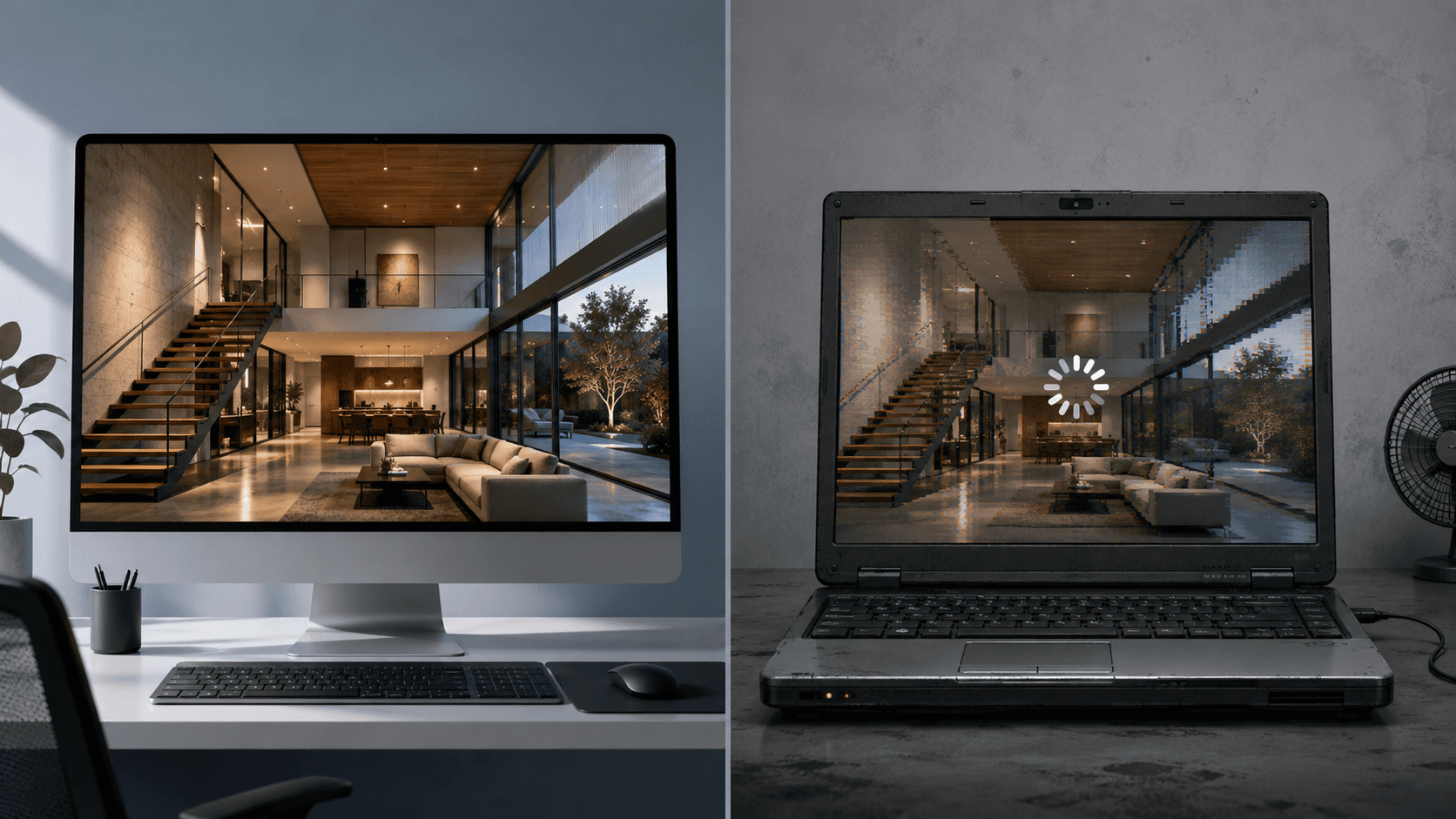
A team spends weeks building a gorgeous interactive walkthrough of a building. Real lighting, real materials, the kind of detail that makes a client lean in. They send it over. And it won't open. Or it opens and crawls like a slideshow, because it ran fine on a workstation with a $3,000 GPU and the client is on a four-year-old laptop.
Here's the thing nobody wants to say out loud. This industry is obsessed with building better digital twins, while the actual problem is that almost nobody can open the ones we already build.
A digital twin you can't deliver isn't a tool. It's a file sitting in someone's downloads folder. So let me walk through what these things are really worth, and the one thing that decides whether anyone ever experiences them.
What Is a Digital Twin?
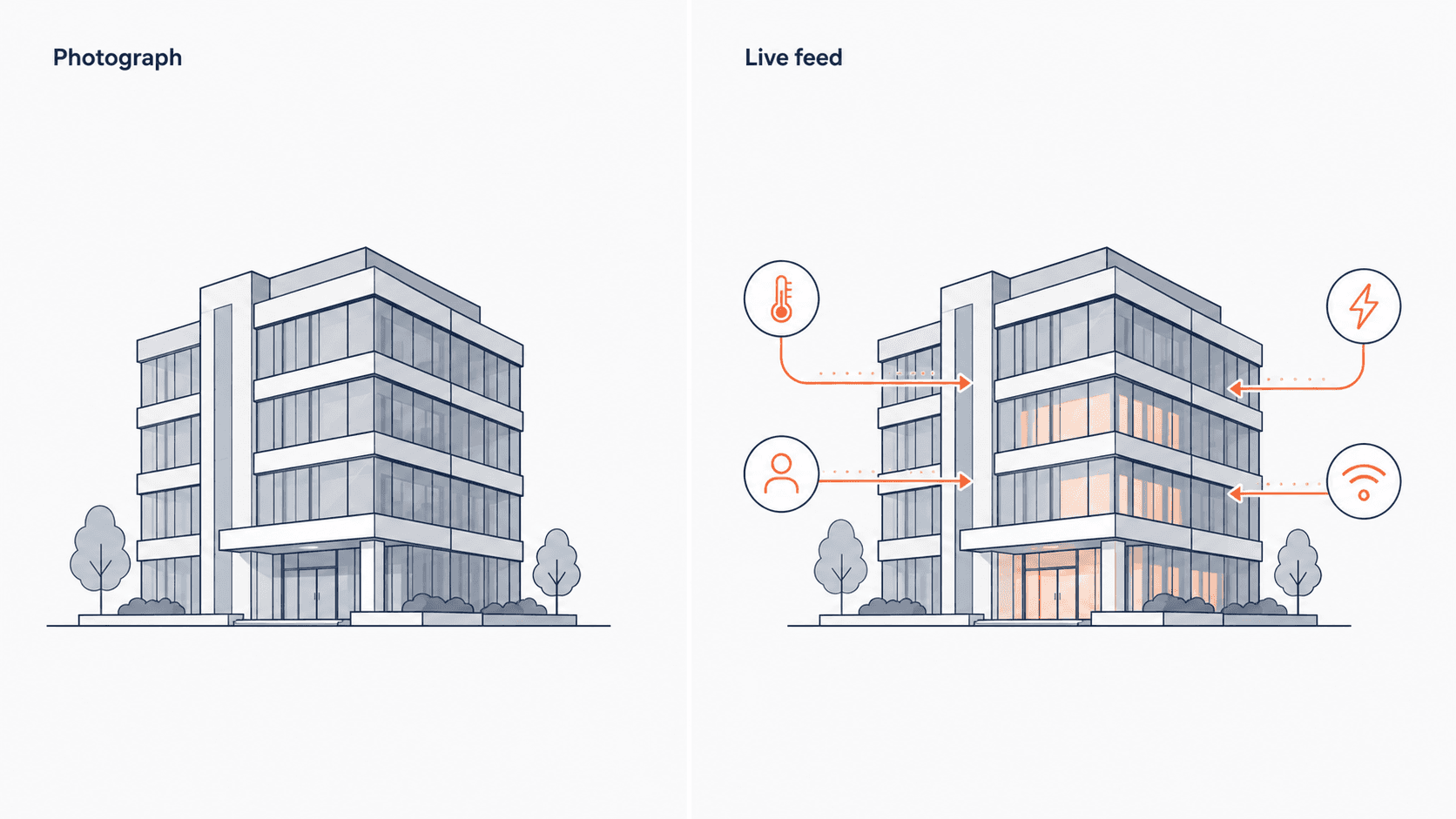
Quick reset, because the word gets thrown around loosely. A 3D model is a photograph. A digital twin is a live feed.
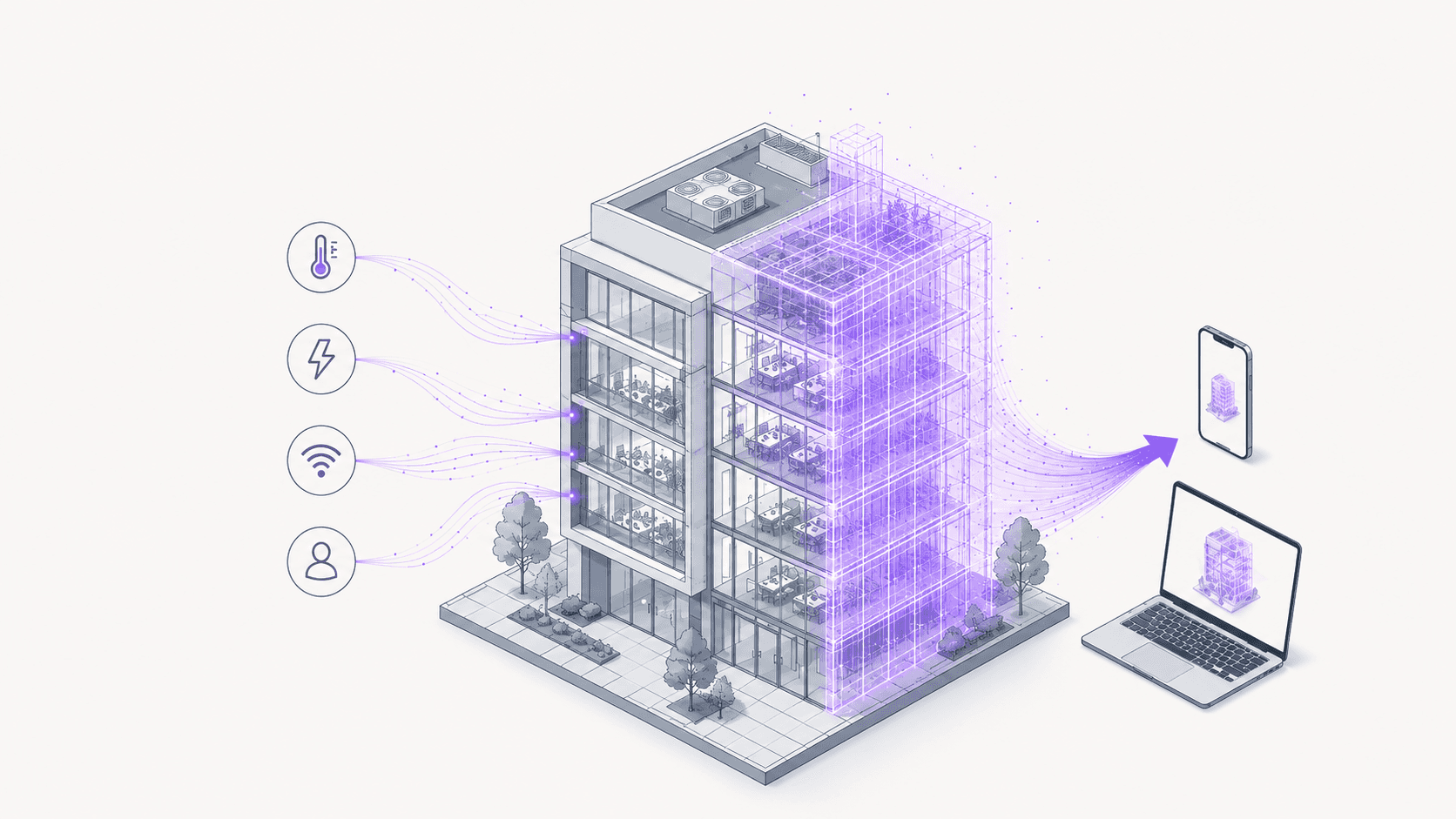
A render shows you what a building looks like. A twin shows you how it behaves. The difference is real-time data: a twin is wired to the actual building through sensors, occupancy counters, energy meters, so the virtual copy changes as the real thing does.
Autodesk grades these in three rungs, and it's a useful way to cut through the marketing.
The descriptive twin is a visual replica with live design and construction data attached, the 3D model and BIM rolled together. The informative twin adds sensor and operations data, so it doesn't just show you the building, it reports on it. The autonomous twin uses AI to predict failures and act on its own, catching the chiller drifting toward a fault three weeks before anyone files a complaint.
Most projects sit on that first rung, and that's fine. You don't need a self-driving building to get value out of one.
But notice the pattern as you climb. Every rung makes the twin richer, more interactive, more detailed. Which also makes it heavier. And the heavier it gets, the harder it becomes to put in front of the one person who actually needs to see it.
That tension runs through everything that follows.
Digital Twin Use Cases in Architecture and Real Estate
Digital twins earn their money in three main places. Each one delivers something real. And each one runs into the same wall.
Design Reviews and Client Walkthroughs
In the design phase, twins are a money-saver before anyone breaks ground. Catch a clash between ductwork and a beam on screen and it's a five-minute fix. Catch it after the pour and it's six figures. A study in Automation in Construction found that using a digital twin in the design phase can cut development time by up to 40% and reduce in-progress modification costs by around 35%.
The bigger win is the client. Someone who can walk through a space before it exists engages differently than someone squinting at a flat render. They catch problems early. They feel like they shaped it. But only if they can open the walkthrough, and a heavy interactive scene is exactly the kind of file that defeats a normal laptop.
Pre-Construction Sales and Virtual Property Tours
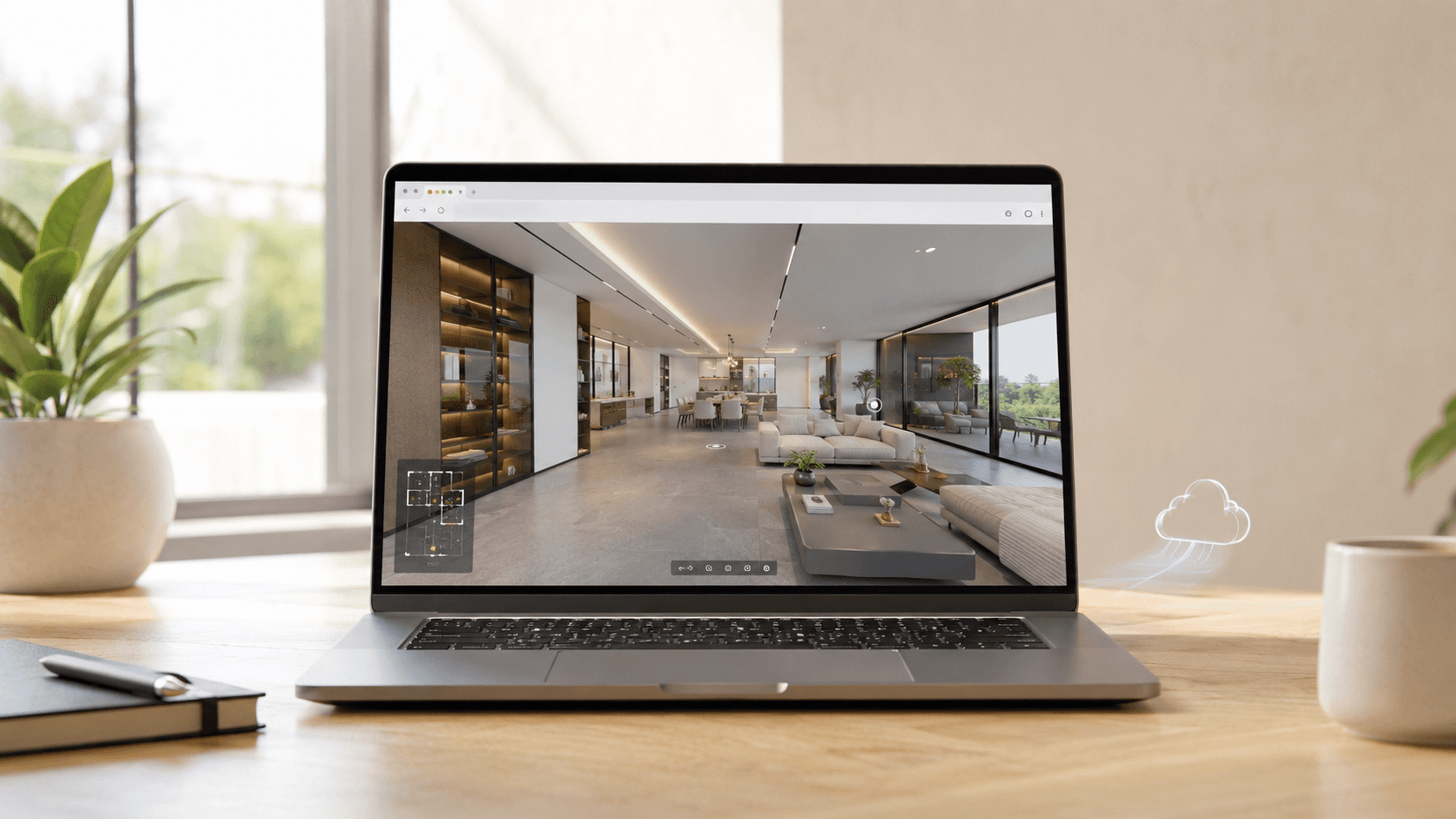
This is where twins quietly print money. A buyer can tour a unit that doesn't exist yet, controlling the walkthrough instead of nodding at a render. Interactive tours build buyer trust, shorten sales cycles, and pull in remote and international investors who can explore a unit from another continent.
Read that again, though. Another continent. On whatever device they happen to own, probably a phone. The entire value depends on a stranger far away opening your experience instantly, and that's precisely where most setups fall apart.
Building Operations and Portfolio Management
On the operations side, twins run buildings. The Edge in Amsterdam uses more than 28,000 sensors and draws roughly 70% less energy than a comparable building, adjusting lighting and climate to where people actually are. For a portfolio, the twin becomes the only sane way to see everything at once.
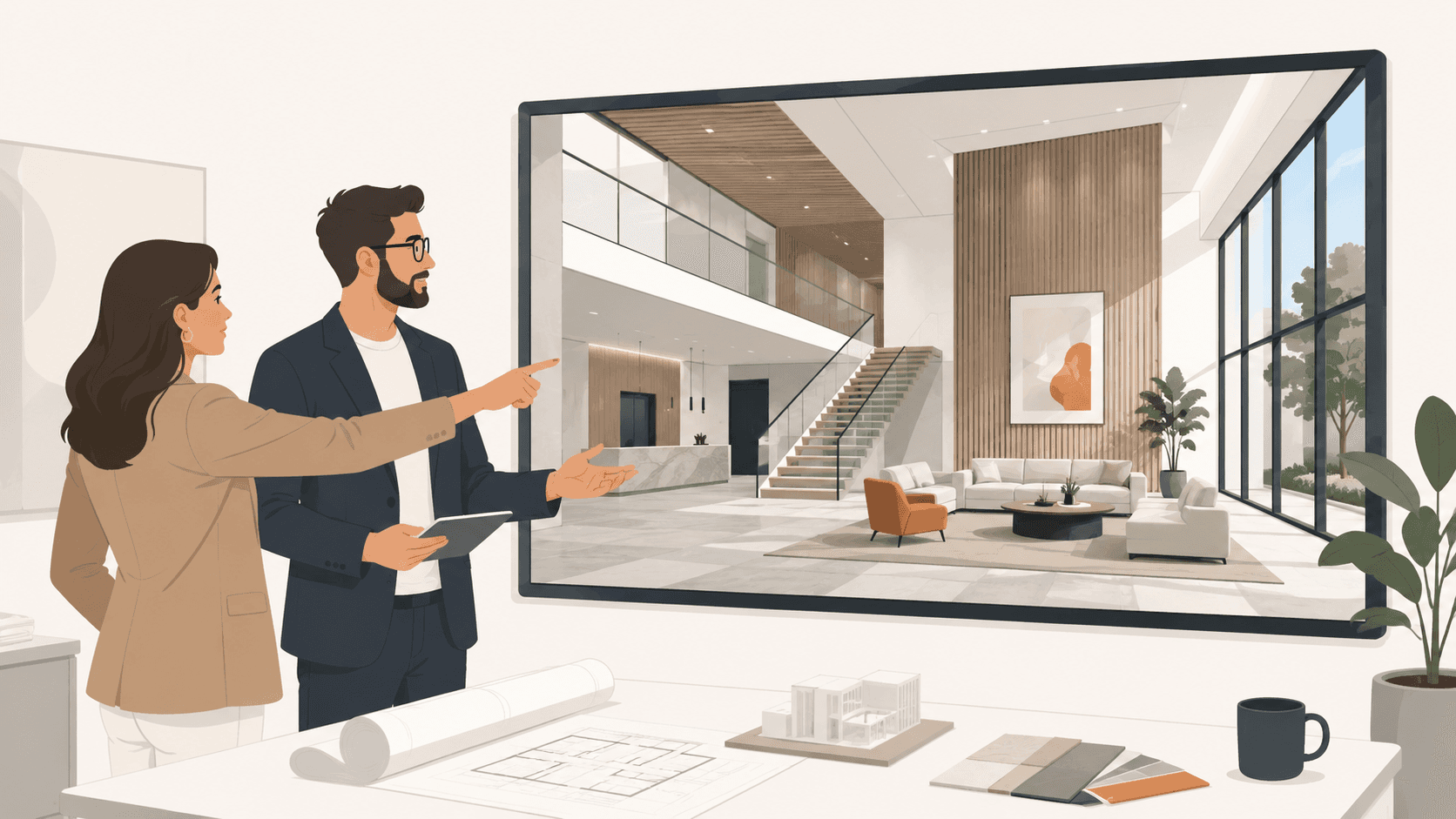
But a facilities team isn't at one desk. They're across sites, on tablets, in the field. The dashboard is worthless if it only runs on the one machine powerful enough to render it.
See the pattern? Three different use cases, three different payoffs, one shared bottleneck. None of it matters if people can't access the thing.
How AI Made Digital Twins Cheap to Build
Here's what changed, and why the delivery problem suddenly matters more than it used to.
Building a convincing interactive twin used to be the hard, expensive part. You needed a specialist team, weeks of work, people who could model and texture and light and optimize a scene until it ran clean. That kept twins in the hands of big firms with big budgets.
That barrier is falling fast. Generative AI now roughs out scenes, produces materials and textures, and spins up layout variations in an afternoon instead of a week. The tools don't replace a skilled hand, but they collapse the distance between an idea and something you can walk through. On the operations side, AI is what turns an informative twin into an autonomous one, reading sensor data and predicting failures without a dedicated data team.
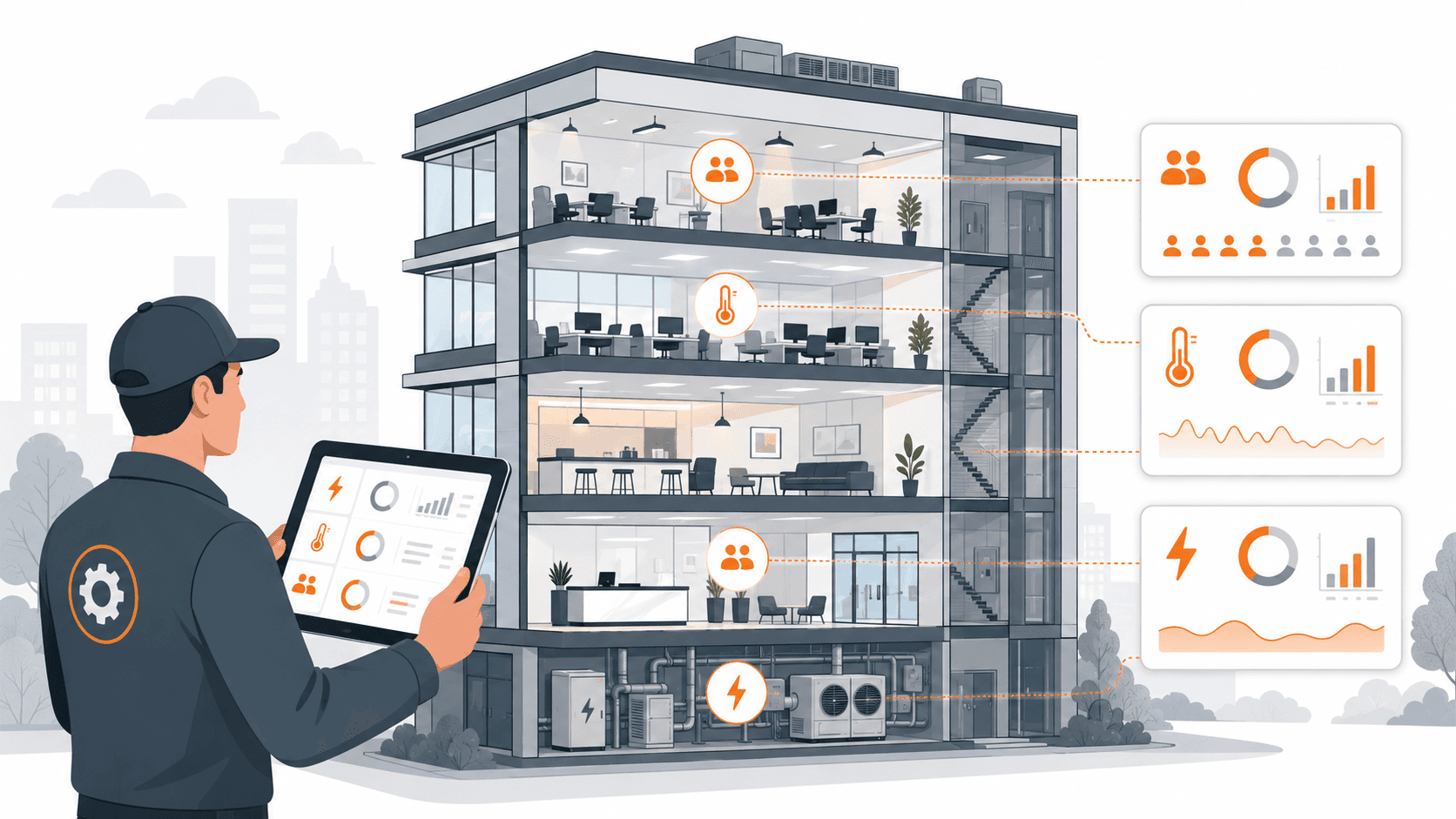
Put it together and the math flips. The hard part of a digital twin used to be making it. Now, more and more, making it is the easy part.
Which means the thing that separates a twin that wins work from one that doesn't is no longer the quality of the build. Plenty of people can build something impressive now. The advantage has moved downstream, to whoever can take that heavy, beautiful experience and put it in front of anyone, on any device, without friction.
That's not a modeling problem. It's a delivery problem. And it has a specific solution.
What Is Pixel Streaming, and Why It Solves the Delivery Problem
The solution is a technique called pixel streaming, and the easiest way to picture it is Netflix for interactive 3D.
If you want the longer version of how this actually works, we broke it down here: what is pixel streaming.
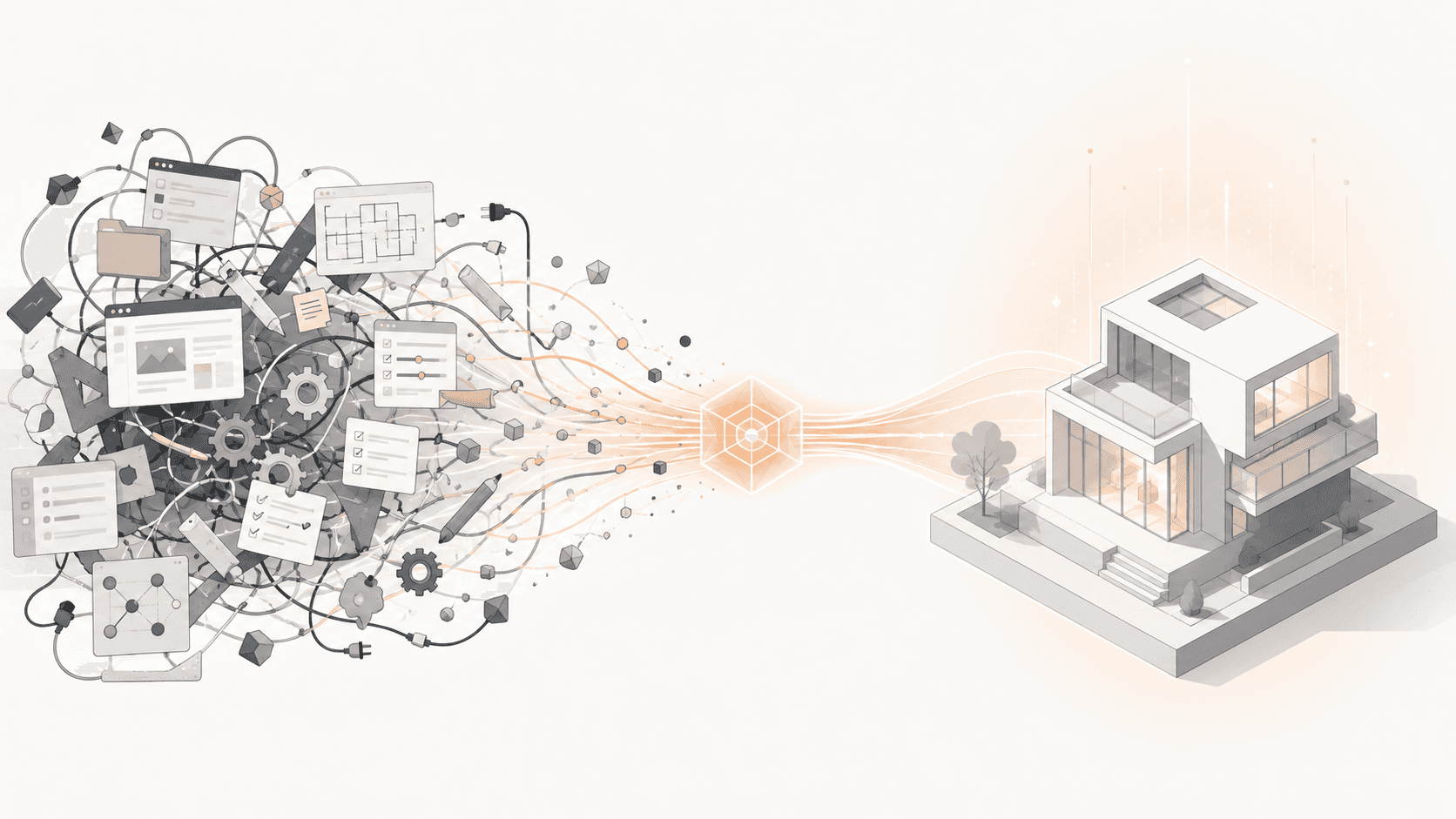
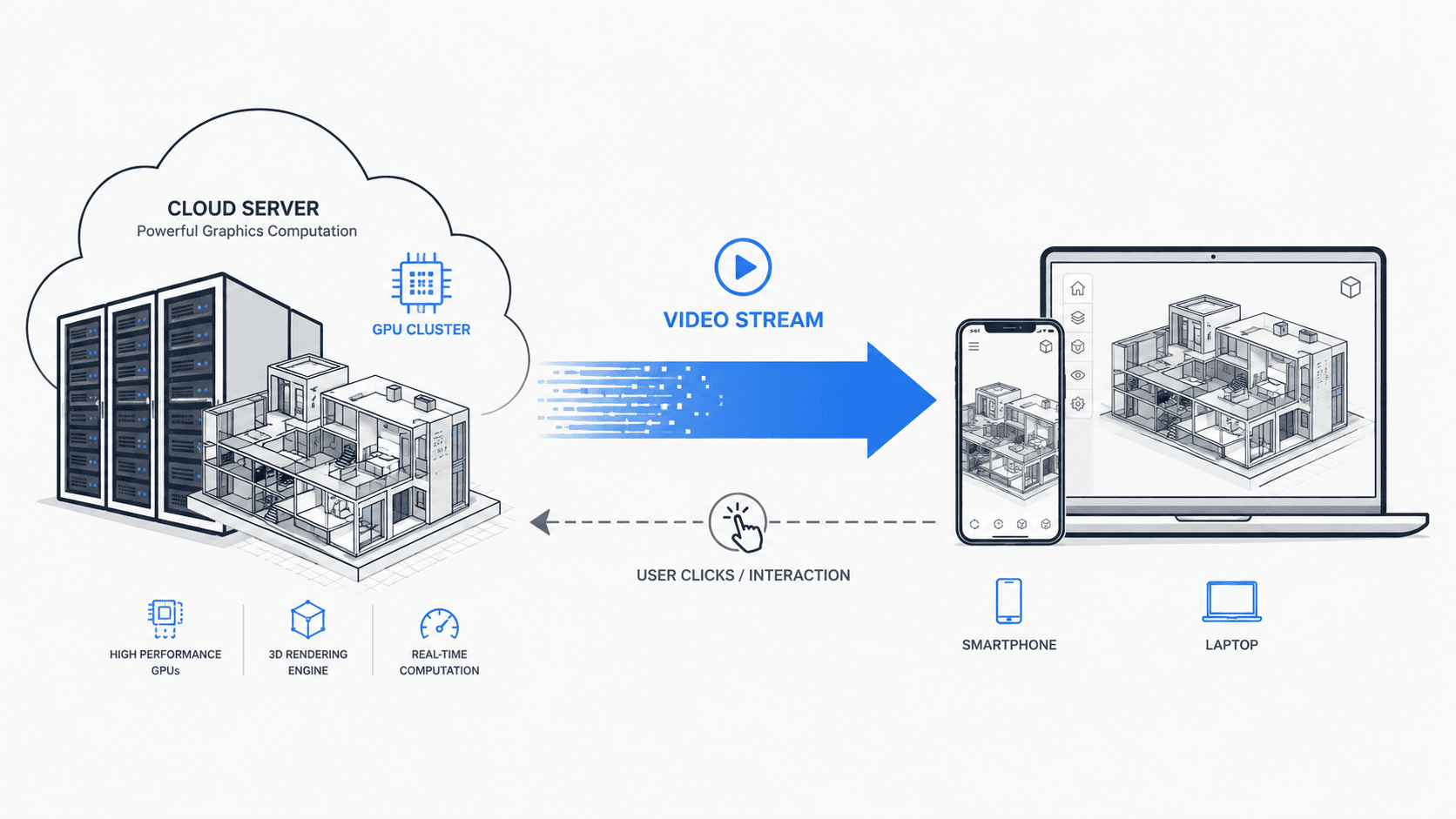
When you watch Netflix, the movie isn't stored on your device. A server does the work and streams you video. Vagon Streams does the same thing for an interactive 3D experience. A powerful machine in the cloud runs your twin and renders every frame. That video streams to the viewer, and their clicks and movements travel back to the server in real time. All the heavy rendering happens server-side, so the experience runs on any device with a browser, with no high-end hardware needed.
Sit with what Vagon Streams removes. No more 12GB file transfers. No system requirements. No "it ran on my machine" support tickets. No asking a buyer to own a gaming rig. The client opens a link, and the twin that needed a workstation now runs on their phone on the train.
This is the missing piece for every use case in this post. With Vagon Streams, the design client who couldn't open the walkthrough just clicks a link. The investor on another continent tours the unit from their phone. The facilities team pulls up the operations twin on a tablet in the field. Same experience, any device, instantly.
And that's the whole idea behind Vagon Streams. It takes your interactive 3D application, an Unreal Engine twin or anything similar, and streams it from the cloud to anyone with a browser. You stop worrying about whether they can run it, because Vagon Streams runs it for them.
Which is worth looking at a little more closely, because the details are where Vagon Streams gets useful.
How Vagon Streams Delivers a Digital Twin to Any Device
So what does this actually look like when you put a twin on Vagon Streams? A few things matter, and each one maps directly to a problem we've already hit in this post.
It runs your twin on any device. This is the headline. Your Unreal Engine twin, or anything built in a real-time 3D engine, runs on a cloud GPU and streams to the viewer as video. A ten-year-old laptop, a tablet, a phone on cellular data. If it has a browser, it runs your twin. The hardware question that kills so many projects simply goes away.
No installs, no downloads, just a link. You don't ship a file. You send a URL. The client clicks and they're inside the experience in seconds. Nobody installs a launcher, nobody clears disk space, nobody opens a support ticket. For a sales team chasing a buyer who's mildly interested, removing that friction is the difference between a tour that happens and one that doesn't.
You can embed it right where people already are. Vagon Streams can live inside your own website or listing page, not just on a standalone link. So a pre-construction unit can carry its interactive twin directly on the page where it's being marketed. The buyer doesn't get redirected anywhere. They're touring the building inside the same tab where they were reading about it.
It scales to a lot of people at once. A single workstation streams to one person. Vagon Streams spins up cloud capacity on demand, so whether it's one investor or a few hundred attendees at a launch event, everyone gets their own smooth, responsive session. You're not rationing access to the one machine powerful enough to run the thing.
It stays responsive. The reason streaming feels like a gimmick when it's done badly is lag. Vagon Streams uses low-latency streaming so the walkthrough responds to clicks and movement in near real time. A laggy twin is worse than no twin, because it makes your beautiful work feel broken. Responsiveness is the whole point.
Put those together and the shape of the solution is clear. You keep building twins exactly how you build them now, in the tools you already use. Vagon Streams handles the part that used to break: getting the finished experience, at full quality, into the hands of whoever needs it, wherever they are, on whatever they're holding.
The twin is the product. Vagon Streams is how it reaches people.
If you're curious what else it handles, here's the full feature list.
Three Real-World Examples: Streaming Digital Twins in Practice
The abstract case is fine, but here's what it looks like in practice. Three scenarios, all built on the same delivery layer.
The international buyer who never gets on a plane. A developer is selling units in a tower that's still a foundation. A buyer in another country is interested but isn't flying in to look at a hole in the ground. The sales team sends a link. The buyer opens an interactive twin of their exact unit on their phone, walks through it, checks the view from the living room window, sees the finishes. With Vagon Streams doing the rendering, none of it depends on the buyer's device. They tour a building that doesn't exist yet, from a sofa 8,000 kilometers away, and they're sold before construction tops out.
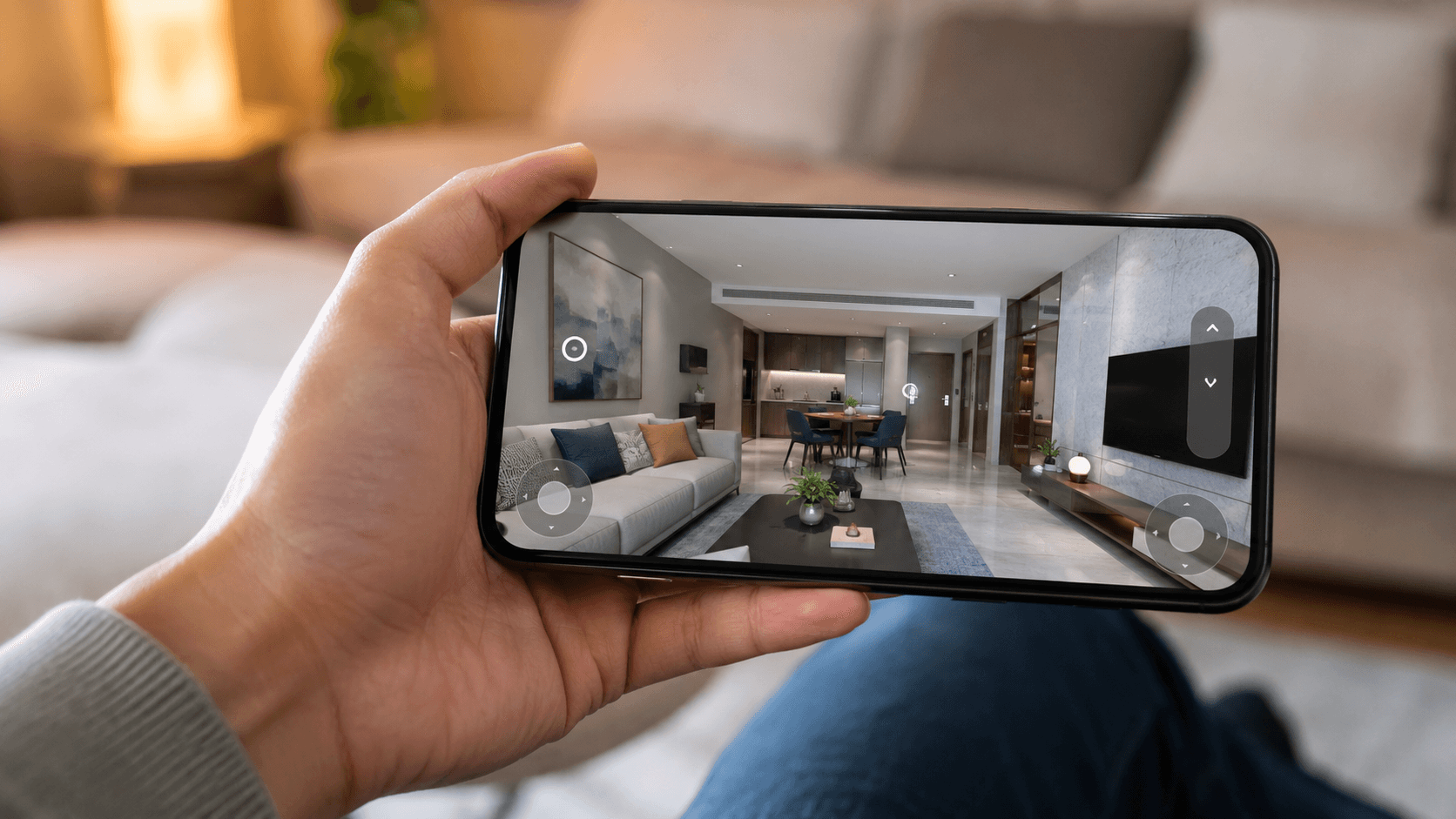
The design review where the client drives. An architecture firm is presenting a concept to a client who has opinions but no technical setup. Instead of screen-sharing a video and narrating, the firm sends a Vagon Streams link and hands the client the controls. The client walks the space themselves, stops where they want, asks why the corridor feels narrow, suggests moving a wall. The feedback is sharper because they're inside it, not watching someone else navigate. And the firm didn't have to ask anyone to install anything.
The twin that lives on the listing page. A commercial developer embeds the interactive twin straight into the property's marketing page. A prospect reading about the building scrolls down and, without leaving the page or downloading a thing, steps inside it. Vagon Streams runs it in the browser, so the experience is right there next to the floor plans and the spec sheet. The listing stops being a brochure and becomes something people actually explore, which is exactly the kind of engagement that moves a deal forward.
Different industries, different goals. The common thread is that in every case the team built something worth experiencing, and Vagon Streams is what let the right person experience it without a single technical hurdle in the way.
If you'd rather see real ones instead of imagining them, browse the Vagon Streams experience gallery.
How to Get Started With Digital Twins
You don't need to commit a portfolio to this on day one. If you're weighing your first project, a few things keep it sane.
Start with one property and a clear goal. Pick a single asset and decide up front what the twin is for: closing remote buyers, sharpening design reviews, running operations. A twin with no target is an expensive dashboard nobody checks.
Match the twin to the job. Selling units or winning a pitch? You want a sharp descriptive twin and a great interactive walkthrough, and you can stop there. Save the sensor networks and AI for the assets where prediction actually moves the numbers.
Get the BIM right. The twin is only as honest as the model underneath it. Sloppy data in, useless twin out.
Decide how people will see it before you build it, not after. This is the step everyone leaves for last and regrets. The moment you know what you're building, set up Vagon Streams as the delivery layer so the finished experience reaches anyone on any device through a link. Plan distribution in from the start and you never hit the wall this whole post is about. If you're ready to price it out, here's Vagon Streams pricing.
That last point is the one I'd burn into the wall above your desk. The technology to build twins keeps getting easier. The discipline to make sure people can actually open them is still rare, and it's the cheapest advantage available right now. Build with delivery in mind, and you skip the failure that catches everyone else off guard.
Where This Leaves You
A few years ago the hard part of a digital twin was building it. That's over. AI and modern tools have made these experiences faster and cheaper to produce than at any point in this industry's history, and the gap keeps widening. Plenty of people can build something impressive now.
So the advantage moved. It's no longer about who builds the best twin. It's about who can put that twin in the most hands, on the most devices, with the least friction. The build is table stakes. Delivery is the edge.
That's the whole argument in one line. A digital twin you can't deliver is just a file on a hard drive. A digital twin anyone can open with a link is a tool that wins work, closes buyers, and runs buildings.
Build the twin however you like, in whatever tools you love. Then let Vagon Streams carry it the last mile, from your workstation to the screen of whoever needs to see it, wherever they are.
That last mile is where the value actually lives. Don't leave it for the end.
FAQs
1. What's the difference between a digital twin and a 3D model?
A 3D model is static. It shows you what a building looks like at one frozen moment. A digital twin is connected to real-time data through sensors and building systems, so it shows you how the building actually behaves: energy use, occupancy, temperature, equipment wear. The model is a photograph. The twin is a live feed.
2. Do my clients need special hardware or software to view a digital twin?
Not if you stream it. A rich interactive twin built in something like Unreal Engine normally needs a powerful GPU to run smoothly, which most clients don't have. With Vagon Streams, the rendering happens on a cloud machine and the experience streams to the viewer as video, so it runs in any browser on any device. The client opens a link, no installs, no downloads, no system requirements.
3. Can a digital twin run on a phone or tablet?
Yes, when it's delivered through cloud streaming. Since Vagon Streams does the heavy rendering server-side, a buyer can tour a photorealistic twin on a phone over cellular data, and a facilities team can pull up an operations twin on a tablet in the field. The device only needs to play video and send back taps and clicks.
4. Are digital twins worth it for smaller projects?
Not always, and it's worth being honest about that. Twins deliver their strongest returns in complex, performance-dependent assets like hospitals, large campuses, and manufacturing facilities, while smaller properties often get better value from lighter tools like a sharp interactive walkthrough. If your goal is selling units or winning a pitch, a descriptive twin you can stream to anyone is usually all you need.
5. What tools are used to build digital twins?
It usually starts with BIM, the Building Information Model, which is the data foundation. From there teams layer in real-time engines like Unreal Engine or Twinmotion for the interactive visuals, and connect sensor and IoT data for the operational side. Increasingly, generative AI handles parts of the scene building, which is what's made twins so much faster and cheaper to produce. If you build in Blender, here's how teams stream Blender projects straight to the browser.
6. How do I share a finished digital twin with a client or buyer?
This is the part most teams underestimate. Emailing a large file usually fails, because the recipient can't run it. The reliable approach is cloud streaming: you put the twin on a platform like Vagon Streams and send a link, or embed it directly in your website or listing page. The viewer experiences the full-quality twin instantly, on whatever device they're holding.
7. Does streaming a twin cause lag?
It can, if it's done poorly, and a laggy walkthrough feels broken. Good streaming uses low-latency technology so the experience responds to clicks and movement in near real time. Vagon Streams is built for this, so the walkthrough feels responsive rather than like watching a delayed video.
You've seen this happen. Maybe it happened to you last week.
A team spends weeks building a gorgeous interactive walkthrough of a building. Real lighting, real materials, the kind of detail that makes a client lean in. They send it over. And it won't open. Or it opens and crawls like a slideshow, because it ran fine on a workstation with a $3,000 GPU and the client is on a four-year-old laptop.
Here's the thing nobody wants to say out loud. This industry is obsessed with building better digital twins, while the actual problem is that almost nobody can open the ones we already build.
A digital twin you can't deliver isn't a tool. It's a file sitting in someone's downloads folder. So let me walk through what these things are really worth, and the one thing that decides whether anyone ever experiences them.
What Is a Digital Twin?
Quick reset, because the word gets thrown around loosely. A 3D model is a photograph. A digital twin is a live feed.
A render shows you what a building looks like. A twin shows you how it behaves. The difference is real-time data: a twin is wired to the actual building through sensors, occupancy counters, energy meters, so the virtual copy changes as the real thing does.
Autodesk grades these in three rungs, and it's a useful way to cut through the marketing.
The descriptive twin is a visual replica with live design and construction data attached, the 3D model and BIM rolled together. The informative twin adds sensor and operations data, so it doesn't just show you the building, it reports on it. The autonomous twin uses AI to predict failures and act on its own, catching the chiller drifting toward a fault three weeks before anyone files a complaint.
Most projects sit on that first rung, and that's fine. You don't need a self-driving building to get value out of one.
But notice the pattern as you climb. Every rung makes the twin richer, more interactive, more detailed. Which also makes it heavier. And the heavier it gets, the harder it becomes to put in front of the one person who actually needs to see it.
That tension runs through everything that follows.
Digital Twin Use Cases in Architecture and Real Estate
Digital twins earn their money in three main places. Each one delivers something real. And each one runs into the same wall.
Design Reviews and Client Walkthroughs
In the design phase, twins are a money-saver before anyone breaks ground. Catch a clash between ductwork and a beam on screen and it's a five-minute fix. Catch it after the pour and it's six figures. A study in Automation in Construction found that using a digital twin in the design phase can cut development time by up to 40% and reduce in-progress modification costs by around 35%.
The bigger win is the client. Someone who can walk through a space before it exists engages differently than someone squinting at a flat render. They catch problems early. They feel like they shaped it. But only if they can open the walkthrough, and a heavy interactive scene is exactly the kind of file that defeats a normal laptop.
Pre-Construction Sales and Virtual Property Tours
This is where twins quietly print money. A buyer can tour a unit that doesn't exist yet, controlling the walkthrough instead of nodding at a render. Interactive tours build buyer trust, shorten sales cycles, and pull in remote and international investors who can explore a unit from another continent.
Read that again, though. Another continent. On whatever device they happen to own, probably a phone. The entire value depends on a stranger far away opening your experience instantly, and that's precisely where most setups fall apart.
Building Operations and Portfolio Management
On the operations side, twins run buildings. The Edge in Amsterdam uses more than 28,000 sensors and draws roughly 70% less energy than a comparable building, adjusting lighting and climate to where people actually are. For a portfolio, the twin becomes the only sane way to see everything at once.
But a facilities team isn't at one desk. They're across sites, on tablets, in the field. The dashboard is worthless if it only runs on the one machine powerful enough to render it.
See the pattern? Three different use cases, three different payoffs, one shared bottleneck. None of it matters if people can't access the thing.
How AI Made Digital Twins Cheap to Build
Here's what changed, and why the delivery problem suddenly matters more than it used to.
Building a convincing interactive twin used to be the hard, expensive part. You needed a specialist team, weeks of work, people who could model and texture and light and optimize a scene until it ran clean. That kept twins in the hands of big firms with big budgets.
That barrier is falling fast. Generative AI now roughs out scenes, produces materials and textures, and spins up layout variations in an afternoon instead of a week. The tools don't replace a skilled hand, but they collapse the distance between an idea and something you can walk through. On the operations side, AI is what turns an informative twin into an autonomous one, reading sensor data and predicting failures without a dedicated data team.
Put it together and the math flips. The hard part of a digital twin used to be making it. Now, more and more, making it is the easy part.
Which means the thing that separates a twin that wins work from one that doesn't is no longer the quality of the build. Plenty of people can build something impressive now. The advantage has moved downstream, to whoever can take that heavy, beautiful experience and put it in front of anyone, on any device, without friction.
That's not a modeling problem. It's a delivery problem. And it has a specific solution.
What Is Pixel Streaming, and Why It Solves the Delivery Problem
The solution is a technique called pixel streaming, and the easiest way to picture it is Netflix for interactive 3D.
If you want the longer version of how this actually works, we broke it down here: what is pixel streaming.
When you watch Netflix, the movie isn't stored on your device. A server does the work and streams you video. Vagon Streams does the same thing for an interactive 3D experience. A powerful machine in the cloud runs your twin and renders every frame. That video streams to the viewer, and their clicks and movements travel back to the server in real time. All the heavy rendering happens server-side, so the experience runs on any device with a browser, with no high-end hardware needed.
Sit with what Vagon Streams removes. No more 12GB file transfers. No system requirements. No "it ran on my machine" support tickets. No asking a buyer to own a gaming rig. The client opens a link, and the twin that needed a workstation now runs on their phone on the train.
This is the missing piece for every use case in this post. With Vagon Streams, the design client who couldn't open the walkthrough just clicks a link. The investor on another continent tours the unit from their phone. The facilities team pulls up the operations twin on a tablet in the field. Same experience, any device, instantly.
And that's the whole idea behind Vagon Streams. It takes your interactive 3D application, an Unreal Engine twin or anything similar, and streams it from the cloud to anyone with a browser. You stop worrying about whether they can run it, because Vagon Streams runs it for them.
Which is worth looking at a little more closely, because the details are where Vagon Streams gets useful.
How Vagon Streams Delivers a Digital Twin to Any Device
So what does this actually look like when you put a twin on Vagon Streams? A few things matter, and each one maps directly to a problem we've already hit in this post.
It runs your twin on any device. This is the headline. Your Unreal Engine twin, or anything built in a real-time 3D engine, runs on a cloud GPU and streams to the viewer as video. A ten-year-old laptop, a tablet, a phone on cellular data. If it has a browser, it runs your twin. The hardware question that kills so many projects simply goes away.
No installs, no downloads, just a link. You don't ship a file. You send a URL. The client clicks and they're inside the experience in seconds. Nobody installs a launcher, nobody clears disk space, nobody opens a support ticket. For a sales team chasing a buyer who's mildly interested, removing that friction is the difference between a tour that happens and one that doesn't.
You can embed it right where people already are. Vagon Streams can live inside your own website or listing page, not just on a standalone link. So a pre-construction unit can carry its interactive twin directly on the page where it's being marketed. The buyer doesn't get redirected anywhere. They're touring the building inside the same tab where they were reading about it.
It scales to a lot of people at once. A single workstation streams to one person. Vagon Streams spins up cloud capacity on demand, so whether it's one investor or a few hundred attendees at a launch event, everyone gets their own smooth, responsive session. You're not rationing access to the one machine powerful enough to run the thing.
It stays responsive. The reason streaming feels like a gimmick when it's done badly is lag. Vagon Streams uses low-latency streaming so the walkthrough responds to clicks and movement in near real time. A laggy twin is worse than no twin, because it makes your beautiful work feel broken. Responsiveness is the whole point.
Put those together and the shape of the solution is clear. You keep building twins exactly how you build them now, in the tools you already use. Vagon Streams handles the part that used to break: getting the finished experience, at full quality, into the hands of whoever needs it, wherever they are, on whatever they're holding.
The twin is the product. Vagon Streams is how it reaches people.
If you're curious what else it handles, here's the full feature list.
Three Real-World Examples: Streaming Digital Twins in Practice
The abstract case is fine, but here's what it looks like in practice. Three scenarios, all built on the same delivery layer.
The international buyer who never gets on a plane. A developer is selling units in a tower that's still a foundation. A buyer in another country is interested but isn't flying in to look at a hole in the ground. The sales team sends a link. The buyer opens an interactive twin of their exact unit on their phone, walks through it, checks the view from the living room window, sees the finishes. With Vagon Streams doing the rendering, none of it depends on the buyer's device. They tour a building that doesn't exist yet, from a sofa 8,000 kilometers away, and they're sold before construction tops out.
The design review where the client drives. An architecture firm is presenting a concept to a client who has opinions but no technical setup. Instead of screen-sharing a video and narrating, the firm sends a Vagon Streams link and hands the client the controls. The client walks the space themselves, stops where they want, asks why the corridor feels narrow, suggests moving a wall. The feedback is sharper because they're inside it, not watching someone else navigate. And the firm didn't have to ask anyone to install anything.
The twin that lives on the listing page. A commercial developer embeds the interactive twin straight into the property's marketing page. A prospect reading about the building scrolls down and, without leaving the page or downloading a thing, steps inside it. Vagon Streams runs it in the browser, so the experience is right there next to the floor plans and the spec sheet. The listing stops being a brochure and becomes something people actually explore, which is exactly the kind of engagement that moves a deal forward.
Different industries, different goals. The common thread is that in every case the team built something worth experiencing, and Vagon Streams is what let the right person experience it without a single technical hurdle in the way.
If you'd rather see real ones instead of imagining them, browse the Vagon Streams experience gallery.
How to Get Started With Digital Twins
You don't need to commit a portfolio to this on day one. If you're weighing your first project, a few things keep it sane.
Start with one property and a clear goal. Pick a single asset and decide up front what the twin is for: closing remote buyers, sharpening design reviews, running operations. A twin with no target is an expensive dashboard nobody checks.
Match the twin to the job. Selling units or winning a pitch? You want a sharp descriptive twin and a great interactive walkthrough, and you can stop there. Save the sensor networks and AI for the assets where prediction actually moves the numbers.
Get the BIM right. The twin is only as honest as the model underneath it. Sloppy data in, useless twin out.
Decide how people will see it before you build it, not after. This is the step everyone leaves for last and regrets. The moment you know what you're building, set up Vagon Streams as the delivery layer so the finished experience reaches anyone on any device through a link. Plan distribution in from the start and you never hit the wall this whole post is about. If you're ready to price it out, here's Vagon Streams pricing.
That last point is the one I'd burn into the wall above your desk. The technology to build twins keeps getting easier. The discipline to make sure people can actually open them is still rare, and it's the cheapest advantage available right now. Build with delivery in mind, and you skip the failure that catches everyone else off guard.
Where This Leaves You
A few years ago the hard part of a digital twin was building it. That's over. AI and modern tools have made these experiences faster and cheaper to produce than at any point in this industry's history, and the gap keeps widening. Plenty of people can build something impressive now.
So the advantage moved. It's no longer about who builds the best twin. It's about who can put that twin in the most hands, on the most devices, with the least friction. The build is table stakes. Delivery is the edge.
That's the whole argument in one line. A digital twin you can't deliver is just a file on a hard drive. A digital twin anyone can open with a link is a tool that wins work, closes buyers, and runs buildings.
Build the twin however you like, in whatever tools you love. Then let Vagon Streams carry it the last mile, from your workstation to the screen of whoever needs to see it, wherever they are.
That last mile is where the value actually lives. Don't leave it for the end.
FAQs
1. What's the difference between a digital twin and a 3D model?
A 3D model is static. It shows you what a building looks like at one frozen moment. A digital twin is connected to real-time data through sensors and building systems, so it shows you how the building actually behaves: energy use, occupancy, temperature, equipment wear. The model is a photograph. The twin is a live feed.
2. Do my clients need special hardware or software to view a digital twin?
Not if you stream it. A rich interactive twin built in something like Unreal Engine normally needs a powerful GPU to run smoothly, which most clients don't have. With Vagon Streams, the rendering happens on a cloud machine and the experience streams to the viewer as video, so it runs in any browser on any device. The client opens a link, no installs, no downloads, no system requirements.
3. Can a digital twin run on a phone or tablet?
Yes, when it's delivered through cloud streaming. Since Vagon Streams does the heavy rendering server-side, a buyer can tour a photorealistic twin on a phone over cellular data, and a facilities team can pull up an operations twin on a tablet in the field. The device only needs to play video and send back taps and clicks.
4. Are digital twins worth it for smaller projects?
Not always, and it's worth being honest about that. Twins deliver their strongest returns in complex, performance-dependent assets like hospitals, large campuses, and manufacturing facilities, while smaller properties often get better value from lighter tools like a sharp interactive walkthrough. If your goal is selling units or winning a pitch, a descriptive twin you can stream to anyone is usually all you need.
5. What tools are used to build digital twins?
It usually starts with BIM, the Building Information Model, which is the data foundation. From there teams layer in real-time engines like Unreal Engine or Twinmotion for the interactive visuals, and connect sensor and IoT data for the operational side. Increasingly, generative AI handles parts of the scene building, which is what's made twins so much faster and cheaper to produce. If you build in Blender, here's how teams stream Blender projects straight to the browser.
6. How do I share a finished digital twin with a client or buyer?
This is the part most teams underestimate. Emailing a large file usually fails, because the recipient can't run it. The reliable approach is cloud streaming: you put the twin on a platform like Vagon Streams and send a link, or embed it directly in your website or listing page. The viewer experiences the full-quality twin instantly, on whatever device they're holding.
7. Does streaming a twin cause lag?
It can, if it's done poorly, and a laggy walkthrough feels broken. Good streaming uses low-latency technology so the experience responds to clicks and movement in near real time. Vagon Streams is built for this, so the walkthrough feels responsive rather than like watching a delayed video.
Scalable Pixel and Application Streaming
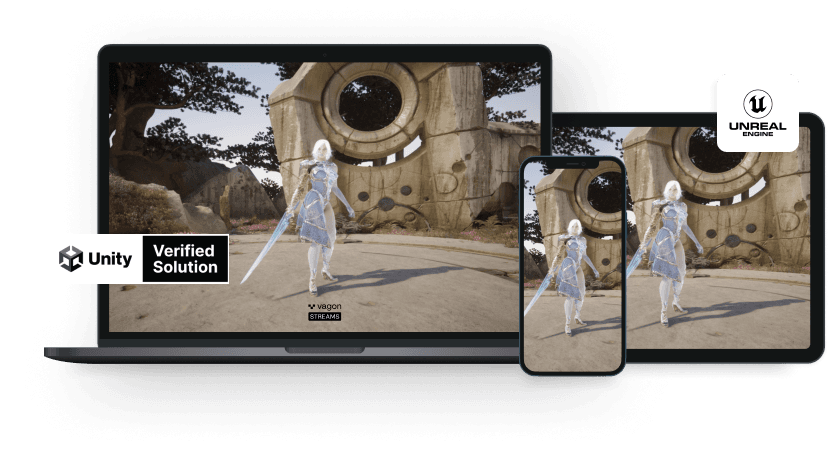
Run your Unity or Unreal Engine application on any device, share with your clients in minutes, with no coding.
Summarize with AI
Ready to focus on your creativity?
Vagon gives you the ability to create & render projects, collaborate, and stream applications with the power of the best hardware.

Run heavy applications on any device with
your personal computer on the cloud.
San Francisco, California
Solutions
Vagon Teams
Vagon Streams
Use Cases
© 2026 Vagon. All rights reserved.
Run heavy applications on any device with
your personal computer on the cloud.
San Francisco, California
Solutions
Vagon Teams
Vagon Streams
Use Cases
© 2026 Vagon. All rights reserved.
Run heavy applications on any device with
your personal computer on the cloud.
San Francisco, California
Solutions
Vagon Teams
Vagon Streams
Use Cases
© 2026 Vagon. All rights reserved.